Three days ago, I wasn’t sure I’d be able to finish this race, so being able to stand on the top step today is really only another testament to showing up, staying curious, and good ol’ fashioned grit. I’m proud of this one.
I’ve been working with Erin Ayala, of Skadi Sports Psychology since the start of the 2024 season, and one of our first conversations was about values. What values did I feel defined me as an athlete, and how could I make those a part of my goals going into each race? The three things that I landed on were: keep showing up, a willingness to chase the dream, and encouraging the next generation.
Ironically, 2024 might just be the year of “less than ideal race preparation” for me. From the stress of finishing my final semester of grad school this spring, to dealing with my ongoing shoulder injury, and chaotic travel delays, its been a season of showing up, giving it my best, and attempting to stay positive about the result.
This was my first time racing ORAMM (Off-Road Assault on Mount Mitchell), and I came into it knowing that the amount of climbing in the race (9,500 ft/2,895m in 60 mi./100km) would be a challenge regardless of how I felt, but that I would have a distinct advantage on the singletrack descents (assuming I was able to get clear of traffic). What I didn’t count on was getting sick after BC Bike Race: I spent the entire two weeks leading up to ORAMM questioning if I would even be able to finish the event. I’ve never felt such intense fatigue on the bike, and described it to my mom as “the absolute exhaustion you get from just standing up, like when you have strep…and all you can think about is that you need to sit down before you collapse.” Except I didn’t have a sore throat or a fever, and tested negative for COVID…which, in my mind, meant that there was no reason NOT to at least start the race.
As I prepared to start the race, I mentally prepared myself for this event to be hard, REALLY hard. I knew that I still wasn’t feeling 100%, and that together, my coach and I had determined that I could push a bit at the start to get into position, then needed to cap my effort at high tempo for the rest of the day. Deep down, I was still questioning whether I’d be able to finish, but was determined to give it my best effort and just see how it went.
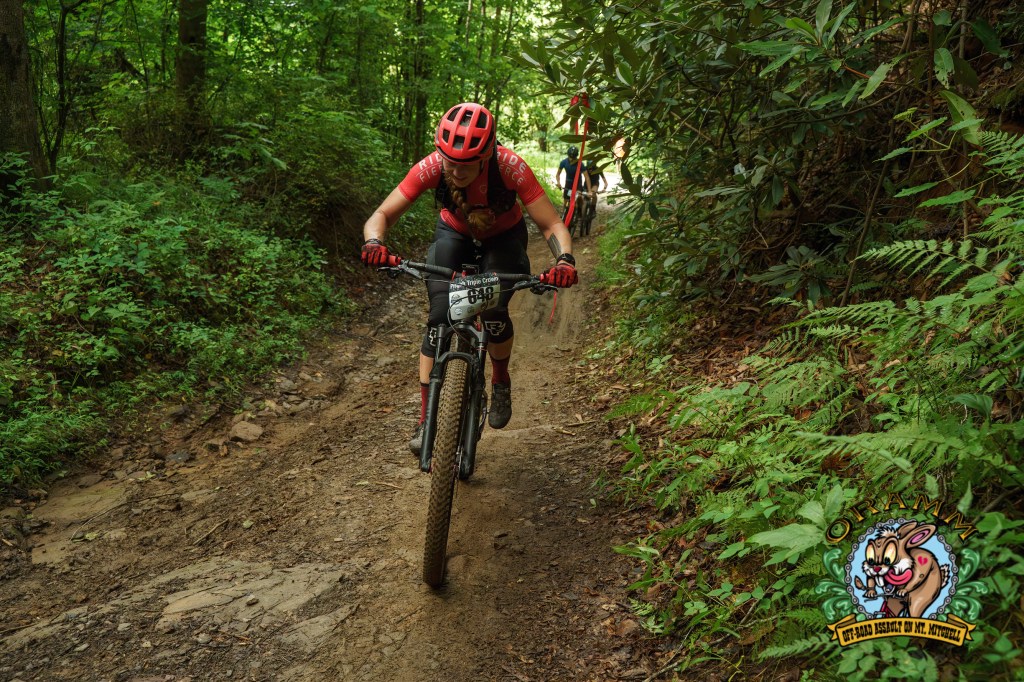
It took me about ten pedal strokes to realize that there would be no “pushing hard” for me this race. I had nothing. The engine was turning, but there was only one gear–and it wasn’t fast. Still, I pushed as hard as I could to attempt to stay with the group through the roll-out and road section that led to the first climb. It was a losing battle, but I hung on as long as I could, then settled in for the long day ahead.
ORAMM’s course has three main climbs in it: one up to Kitsuma, one up Curtis Creek Road and the Blue Ridge Parkway up to Heartbreak Ridge, and a final, shorter climb to Bernard Mountain Trail. As I reached the turn towards Kitsuma (which seems like it should be the top of the first climb, but is most definitely not), a random onlooker shouted, “You’re the first female!” This information was gold, as I had no idea up until that point if there were any women up the road ahead of me, due to the chaos of the mass start format. It also changed my racing, as I no longer had to fight to chase down the “possible rider in first,” but only had to maintain my position on the climbs, and stay safe on the descents.
Despite hearing horror stories of ORAMM’s traffic on the descents, I found nearly everyone to be quick to move over as I came up behind them on each of the descents, and didn’t feel like that was a defining feature of the race. On Kitsuma, I was held up in traffic for a short section of trail, but managed to pass probably 10-12 riders. I passed another 8-10 riders on Heartbreak, though also held some of those same riders up when my front wheel left the chat and I slammed into the trail without warning (and was a bit slow to get up after the shock of hitting the ground so unexpectedly). Oops.
For me, the defining feature of the race was, as expected, the climbs. Curtis Creek and the ensuing Parkway climbs nearly broke me. I wanted so much to be able to push, but found I could only keep spinning my way slowly up. Despite consistently eating and drinking, my race felt more like survival than racing, and could be aptly described as a ‘death march.’ By time I made it to Heartbreak, I was excited, knowing the TREAT of a descent that awaited me. What I didn’t anticipate was that my legs would be cramping the entire way down…or that my upper body would be so fatigued that when I did get caught behind other riders, I would be praying for them to move over because any prolonged braking immediately resulted in debilitating arm pump that made me question whether I would be able to continue holding on to the bars. Still, I had a FANTASTIC time rocking and rolling and letting ‘er eat all the way down to the “Heckle Rock.”
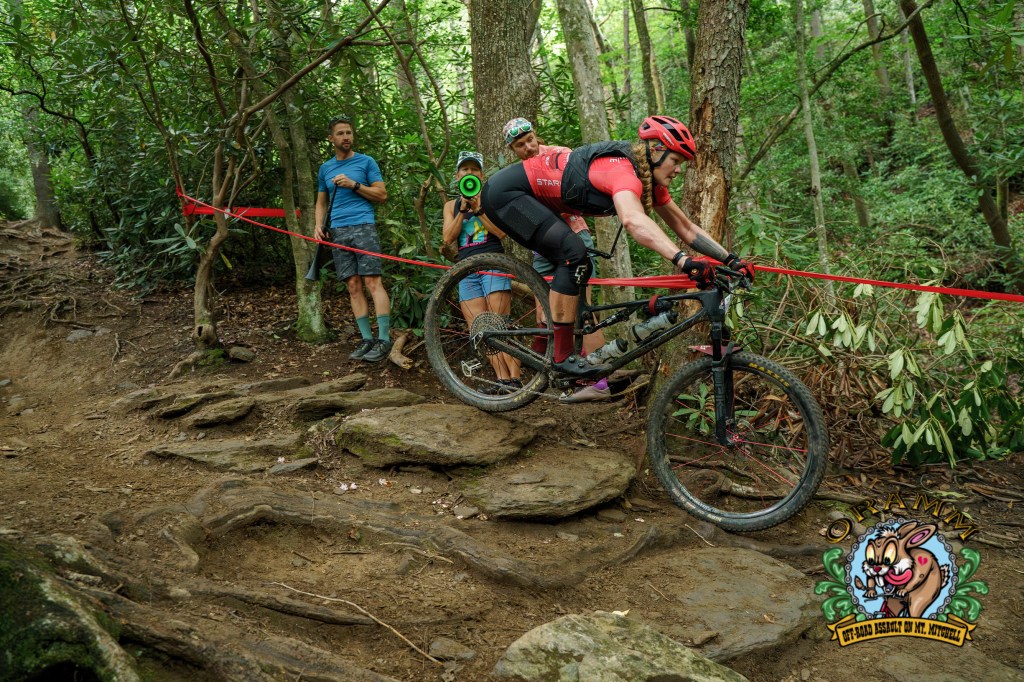
The “Heckle Rock” is legendary in ORAMM, and though I had ridden Kitsuma and Heartbreak Ridge previously, I had never ridden down that section of Star Gap, so I didn’t really know what I was getting into. But I knew it was coming when I could hear yelling through the woods ahead of me, so prepared myself mentally to ignore the crowd and focus on the trail ahead. There were two or three switchbacks leading up to the section of rocks where the crowd had gathered, and as I came through each of them, I was pushing to close the gap between me and the rider ahead of me on the hunch that whatever the line was through the heckle section, he would know it. He slowed a little and went left, so I followed, quickly noting that there seemed to be to possible lines–one to the right that involved wet dirt and roots, and the left line that was essentially a big rock roll made out of smaller slabs. Due to not hesitating (or braking) coming into the rocks, I nearly passed him on the “Heckle Rock,” which gave the hecklers plenty of ammunition: “Yeah girl, show him how it’s done!” “Don’t want to get passed by a girl” “Send it!” etc. (As a side note, I realized partway down Heartbreak Ridge that I was riding faster and more confidently than I would have expected, given the wet conditions, and took that to be a result of spending seven days racing blind at BC Bike Race!)
As I started the final climb up to Bernard Mountain Trail, I felt like I was barely moving. If I started the race on empty, I was now REALLY empty. But I also knew that if the bystander at the start of Kitsuma was right, and I was the lead female rider, that no one was going to make up time on Heartbreak–all I had to do was finish. So I did. I kept the pedals turning, albeit barely, and eked every bit of flow and momentum that I could out of the flowy descent to follow.
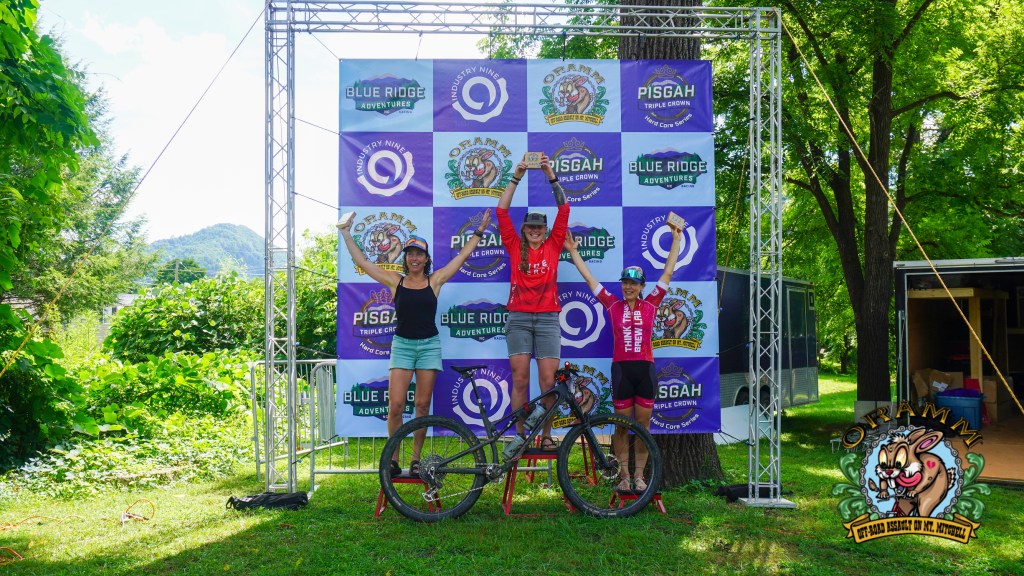
When I crossed the finish line and heard them announce that I had won, I was still in a bit of disbelief. I felt so awful, and so slow… yet somehow still won. I didn’t win because I was fast. I didn’t win because I was strong, or had a good day. I only won because I showed up, stayed curious, and was willing to just “survive” a really hard day on the bike…and sometimes, that’s all it takes. Honestly, pushing through a brutally hard day like this is harder mentally than feeling good on the bike–even if the physical effort as told by the data might indicate otherwise. So even though my finish time was 45 minutes slower than I projected, I’m proud of this result.
I showed up.
And won.
 Ride Fierce Racing