They say hindsight is 20/20, but that clarity never comes if you never take the time to reflect. It’s equally true that a single number, in isolation, cannot possibly tell a full story.
Though it’s an exaggeration, I feel like, in the races that mattered, I finished last (or close to last) nearly every time this season. For any one of those events, if I looked at just my “fitness” numbers, I should have had stellar results. But I didn’t. I struggled at Enduro Nationals in June, and fell apart at XCM Nationals in July… and only started feeling like myself again in September.
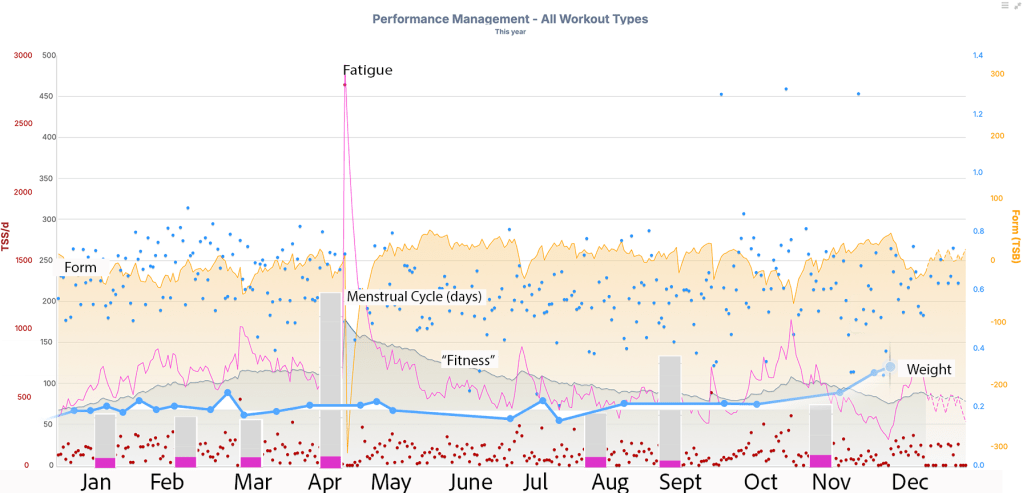
This chart overlays my menstrual cycle tracking onto the Training Peaks performance management chart (along with a graph of my weight), and the combined data begins to show just how much of a hole I dug for myself after Rockstar (late April, that huge fatigue spike). Still, it’s impossible to see the added mental stress of driving 7,000 miles, working full time, and riding for nearly a month straight in terrain right at the edge of my skill level for most of May and June.
The weight gain since September, though frustrating, is what actually clued me into the fact that my body may only just now be finally recovering fully from what was likely some pretty acute overtraining: overtraining, that in the moment, was masked by the abrupt return to heat and humidity mid-summer when I got back to VA and the excuse of general “tiredness” (along with some definite underfueling). The missed menstrual cycles should have been a red flag… but in the chaos, I didn’t realize until afterwards just how many weeks had passed.
In short, my poor race performance this summer might have been partially due to heat and humidity, but it more likely was my own fault for thinking I could somehow manage an ultra, two XCM races, four enduro races, and an XC stage race all in less than two months (plus riding nearly every day). ☠️
In hindsight, there’s a number of things I could have done differently: planning my race schedule better, saying “no” to events when I knew I wasn’t recovered, nutrition, rest days while on the road, etc. All of it starts, however, with listening to my body instead of pushing past known fatigue.
So what about next year?
If I’m entirely honest, the repeated “DFL” performances this summer are still in my head. One of my strengths as a bike racer is that I just keep showing up… but there’s definitely a part of me that’s currently very hesitant to set any “big audacious goals” for 2026. The irony is that, this time last year, I still wasn’t even allowed to ride a bicycle post-shoulder surgery–and still, I was excited for the season and ready to see what I could do. This year, if anything, I’m discouraged. I’m stoked to be riding, in the gym, and putting in the work, but I can’t seem to summon any sort of hope that the work will actually make me faster–or, really, even get me back to the pace I had prior to Rockstar.
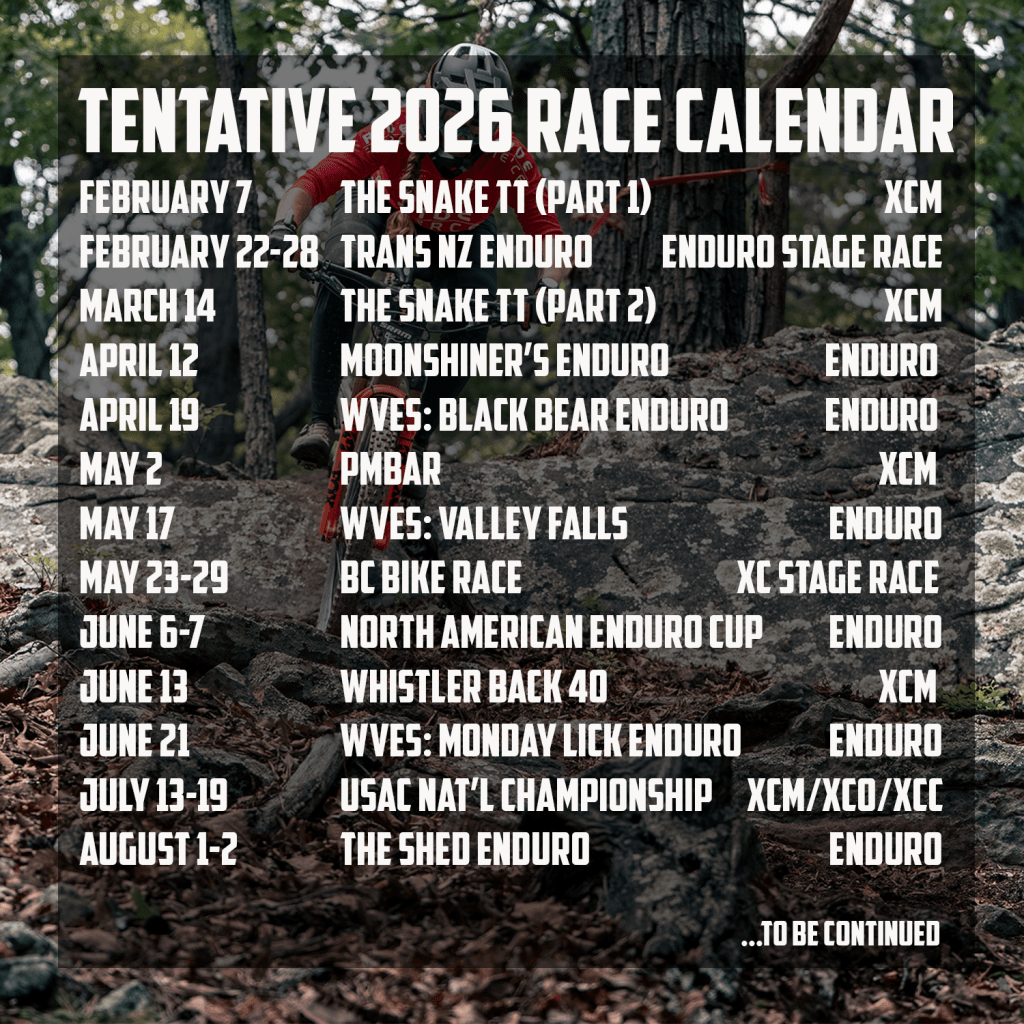
The first half of my season is pretty set. I have some really rad races on the calendar that I’m really excited about. But voicing any kind of goals surrounding results or performance just isn’t something I can manage yet–maybe just because I’m suddenly afraid to fail, or at least to keep failing?
All of this is still very raw. Its an ongoing conversation with my sports psychologist and my coach and myself…and, very likely, still part of the ongoing recovery from failing to listen to my body this spring.
So for right now, the goals I do have for next year are a bit more general:
- Become the best mountain biker I can be through consistently showing up, intentionally developing skills and confidence on the bike, and putting in the work.
- Learn to honor rest and recovery as part of the process. Know that there will be seasons where I’ll have to push through fatigue, but also that those seasons come with a cost and will require intentional rest to manage successfully.
- Keep working to fuel consistently, both on and off the bike.
In the end, I probably need to just come back to my mantras for 2025:
Stay Curious.
Believe in what could be possible.
That might be enough.
 Ride Fierce Racing